New probes at Turkey’s boat-shaped mound add data—and caution—to the Noah’s Ark debate.
When iResearch Weekly last examined the Durupinar Formation, the story was still mostly about shape and radar. The 157-meter ridge, about 18 miles south of Mount Ararat, looked from the air like a hull. Ground-penetrating scans hinted at corridors and chambers. Those earlier reports, written before this summer’s intensive sampling and cores, left the central question open: natural formation, or something built?
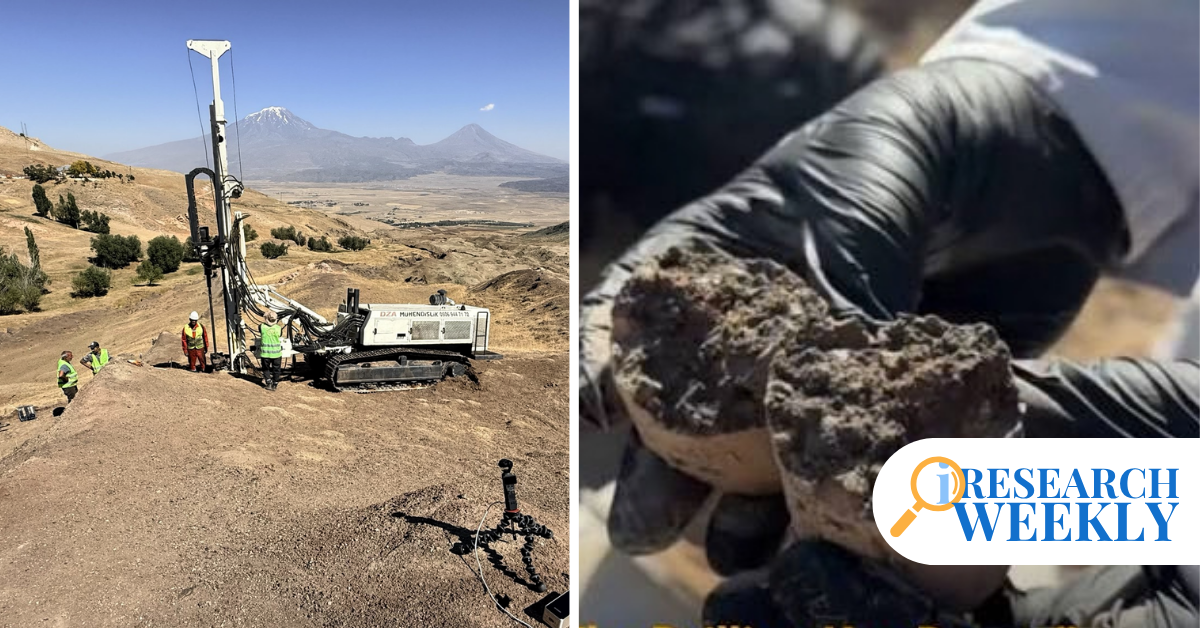
The 2026 field season, led by Prof. Dr. Cenker Atila of Sivas Cumhuriyet University, has now closed that first chapter and opened a messier one. An international team of about 20 researchers spent roughly 90 days on the slope. They mapped the site in two and three dimensions, collected nearly 1,000 soil samples from 150 points, pulled cores, and recovered pottery fragments whose age is still unknown.
Radar again showed the feature that first drew attention: subsurface anomalies with relatively regular edges and right-angle intersections. Team members have cautiously said the patterns could resemble compartments.

Soil chemistry is the second lead. Preliminary measurements found carbon levels inside the formation about 40 percent higher than outside it. “The amount of carbon coming from the interior of the ship is 40 percent higher than what was found outside,” Atila said. He described the difference as a possible sign of organic material, perhaps including wood.
Andrew Jones of Noah’s Ark Scans, which supports the work, has been more direct about motive while insisting on method. “We believe the Durupınar Formation is the remains of Noah’s Ark, and that is exactly why we want to put it through the strongest scientific testing we can,” he said after specialized radar was deployed at the site.
None of this settles the argument. A 1996 geological study by Lorence G. Collins and David Fasold treated Durupinar as a syncline shaped by erosion, not a vessel. That paper still stands as the main competing explanation. While the matching length to the 300 cubits of Genesis 6:15 is striking; it is not proof.
Cores and samples are now in Ankara. Lab work through winter 2026–2027 will look at composition, organic remains, and, if suitable material turns up, radiocarbon dates. Results and conference papers are planned for 2027 under the title “Durupinar Formation 2026 Research.”
Our earlier piece captured the hope that scans alone might decide the question. The new season shows why they cannot. Right angles and extra carbon, while exciting, justify the next round of tests. They do not yet turn a hillside anomaly into an ark.
What they do is keep the door open. If the labs find dated wood, worked timber, or artifacts that belong to a real structure rather than a fold in the terrain, the mountains of Ararat will suddenly feel closer to the oldest story many people still tell. Even a firm geological answer would be a gift: it would replace rumor with measurement. Either way, the next year of analysis is worth watching.
If you believe this expedition is exciting, or a waste of time, tell us below.