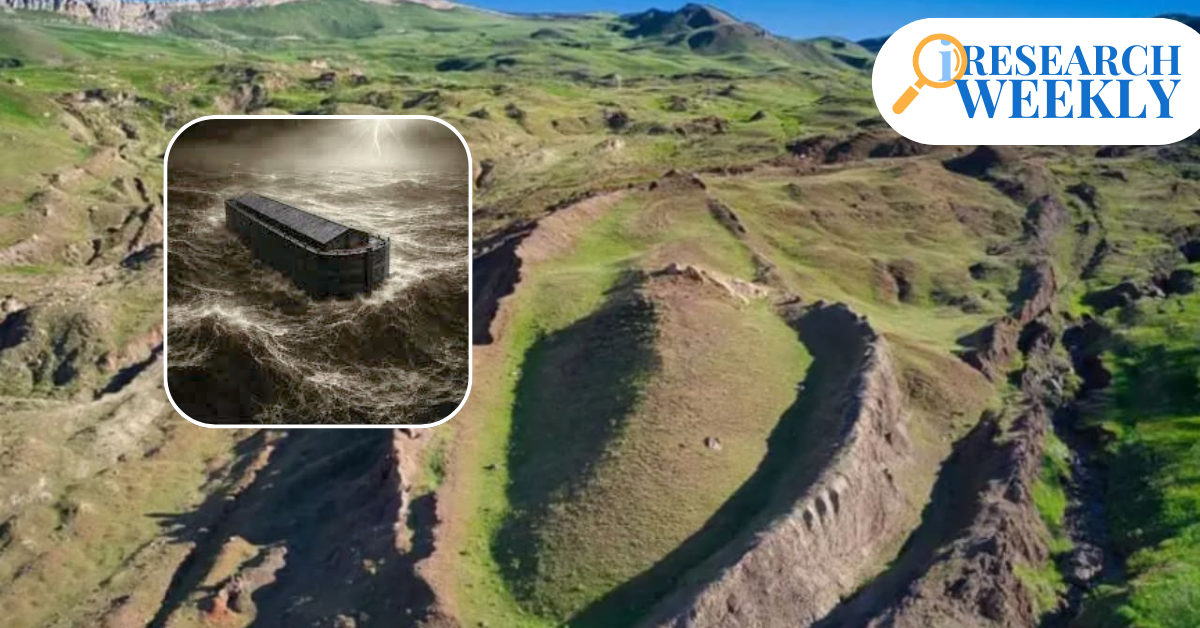
A team of American researchers working on Turkey’s Mount Ararat now claim to have identified hidden tunnels beneath a site believed by many to be the resting place of the biblical Noah’s Ark.
From colorful children’s books filled with cartoony illustrations of giraffes and monkeys aboard a roofed boat to Hollywood films like 2014’s Noah, starring Russell Crowe, the story of Noah’s Ark has captivated imaginations for generations—and for millennia.
Beyond the familiar biblical account in the Hebrew Bible, more than 200 distinct flood legends appear across cultures worldwide, spanning every inhabited continent and reaching back to the Bronze Age and even earlier. With that in mind, this latest development offers a spark of possibility: we may be inching closer to confirming the truth behind the ancient tale.
In a Fox News interview on Wednesday, “Fox & Friends First” spoke with Noah’s Ark Scans researcher Andrew Jones, who suggested that an anomalous formation located in Turkey, believed by many to be the place where Noah’s Ark came to rest, may indeed be authentic. According to Jones, his team has uncovered some intriguing findings beneath the surface.
“Our new research has shown there are tunnels, about four meters down and about two meters high, going down the center of the boat and on the inside edge of the hull shape,” said Jones to the Fox & Friends hosts.
He also noted that features resembling “support beams and walls” point toward the likelihood that the formation on Mount Ararat appears to be a “man-made object, and not just a natural formation.”
Of course, the site has its share of skeptics. Many geologists maintain that the strange mountainside boat shaped protrusion can be explained by natural geological processes. Addressing these concerns, Jones emphasized that not only does the location align with the biblical narrative, but so do its proportions. According to the Book of Genesis, Noah’s vessel measured 300 cubits long, 50 cubits wide, and 30 cubits high—dimensions that match the site on Mount Ararat.
“We have the ship shape, and we’re in the right location, and now we’re also seeing that the soil inside is different from right outside the formation,” claimed Jones, highlighting a threefold spike in organic matter directly inside the area of the site.
Looking ahead, the team’s next step is to obtain permission from a Turkish university to develop a robot capable of descending into the tunnels to “film and take samples.” It is an ambitious plan, but one that carries a sense of excitement and discovery.
When asked directly about his belief in the site’s authenticity, Jones was confident. “Yes, I do believe that this is the real, decayed, buried remains of Noah’s Ark, the famous ship. And we’re doing our best to convince the skeptics and show the world this site.”
Whether the findings ultimately turn out to confirm the site as legit is yet to be seen—but for the many with faith, the evidence is already in.