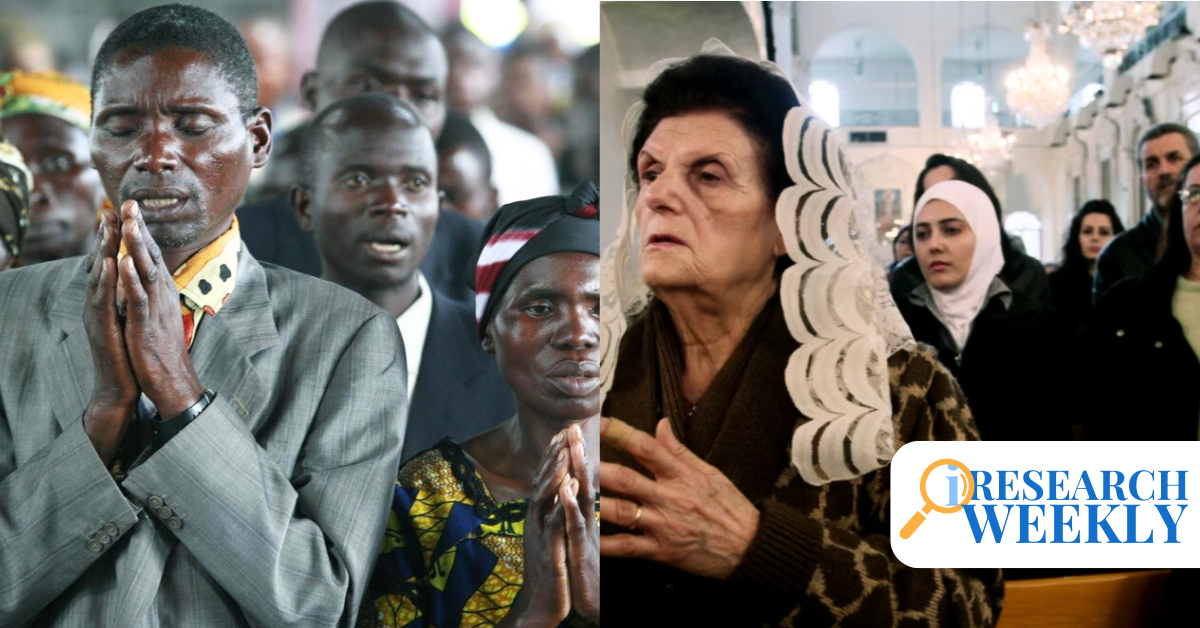
From the heart of the Democratic Republic of the Congo (DRC) to the war-torn streets of Syria, Christians are increasingly finding themselves targeted by extremist Islamist groups.
Christian communities around the world are facing an alarming rise in violence and persecution, with incidents of mass killings, kidnappings, and forced conversions increasing across the Middle East and Africa.
In the DRC, attacks against Christians by the Islamist group Islamic State Central Africa Province (ISCAP) have escalated dramatically in recent weeks. At least 70 Christians have been killed since the beginning of March, with the deadliest incident occurring on March 5 in Ituri Province. ISCAP terrorists slaughtered believers in the towns of Sambuco and Makayana, also burning down homes and motorcycles. The terrorist group claimed responsibility for the attack, boasting about their actions on social media platforms used by the Islamic State. This brutal violence continued over the weekend, with 20 more Christians killed in North Kivu’s Lubero District, and another seven later in the week across North Kivu and Ituri.
The frequency and intensity of ISCAP’s attacks have been rising since the beginning of the year, with over 287 Christians killed in the DRC since Christmas 2024. These attacks form part of a larger conflict in the region, where the M23 rebel group, supported by external forces, has intensified violence. Amid the broader instability, Christians have become easy targets for extremists who see them as enemies of Islam.

The scale of violence has shocked local communities and international observers alike. Christians are not only victims of indiscriminate violence but also face targeted assaults due to their faith.
Meanwhile, in Syria, a similar pattern of persecution is unfolding, although it remains largely unreported. Since the fall of Bashar al-Assad’s regime in December 2024, the country has been gripped by chaos. The new government, led by former Islamist militants from the Hay’at Tahrir al-Sham (HTS), has overseen a rash of extremist persecution, targeting religious minorities.
In addition to Syrian Christians, the country’s Alawite communities (a secretive sect of Twelver-Shia Islam, to which Assad belongs), have been the victims of Sunni terror groups, following failed attempts by Alawite militias to take back the reigns of political power in the country. Militias, many with ties to groups like ISIS and al-Qaeda, are rampaging through Christian neighborhoods — murdering, kidnapping, and harassing the local population.
Manuel Abu Ali, founder of Middle East Christian Aid (MECA), described the dire situation in Homs, where his team had to hide from militias targeting both Christian civilians.
“This is a reality they face every single day. Except, there are no heroic soldiers coming to defend them. They’re on their own,” Abu Ali said.
The violence in Syria is compounded by the country’s deep ethnic and sectarian divides. As the new Sunni government struggles to establish control, Christians and other religious minorities are at risk of being purged from the areas they have inhabited for centuries. In some regions, Christian churches have been attacked, and Christian women forced to wear the veil under threats of violence. Kidnappings, often for ransom, have become widespread, with Christian families bearing the brunt of these brutal acts.
Abu Ali highlighted the fear among the Christian community in Homs, many of whom are widows and families who have lost loved ones to kidnappings and killings. One widow “tragically had lost her husband just a month before. He had a heart condition, and he was brutally attacked on the street by a group of men. This caused his heart to stop, leaving him dead on the street and [her] to raise their two sons alone,” Ali explained.
Another widow’s husband, Ali explained, was kidnapped by Alawite gangs demanding ransom, only for them to kill him anyway. These kinds of kidnappings have been happening more frequently since the new regime’s takeover, Ali said.
The Syrian Christians’ plight, much like those in the DRC, is exacerbated by a lack of protection and visibility. Christian communities in the Middle East are small and scattered, often with little to no defense against large and powerful armed groups. Because of their vulnerability and lack of political representation, these communities face significant threats without any form of external support.
Both the DRC and Syria illustrate a larger trend: the persecution of Christians is becoming more widespread and systematic, especially in regions dominated by Islamic ideology. While some governments in the West have taken action to condemn these attacks, international responses have largely been muted. The violence against Christians in Syria, in particular, has not garnered the media attention it deserves.
The convergence of these stories of persecution underscores a global crisis that needs more than just acknowledgment. The protection of Christian minorities in the DRC and Syria is critical to preserving the last remnants of these ancient communities in the Middle East and Africa. If Christians are to survive in these regions, it is imperative that the international community responds with urgency, offering not only humanitarian aid but also diplomatic and security support to safeguard their future.