
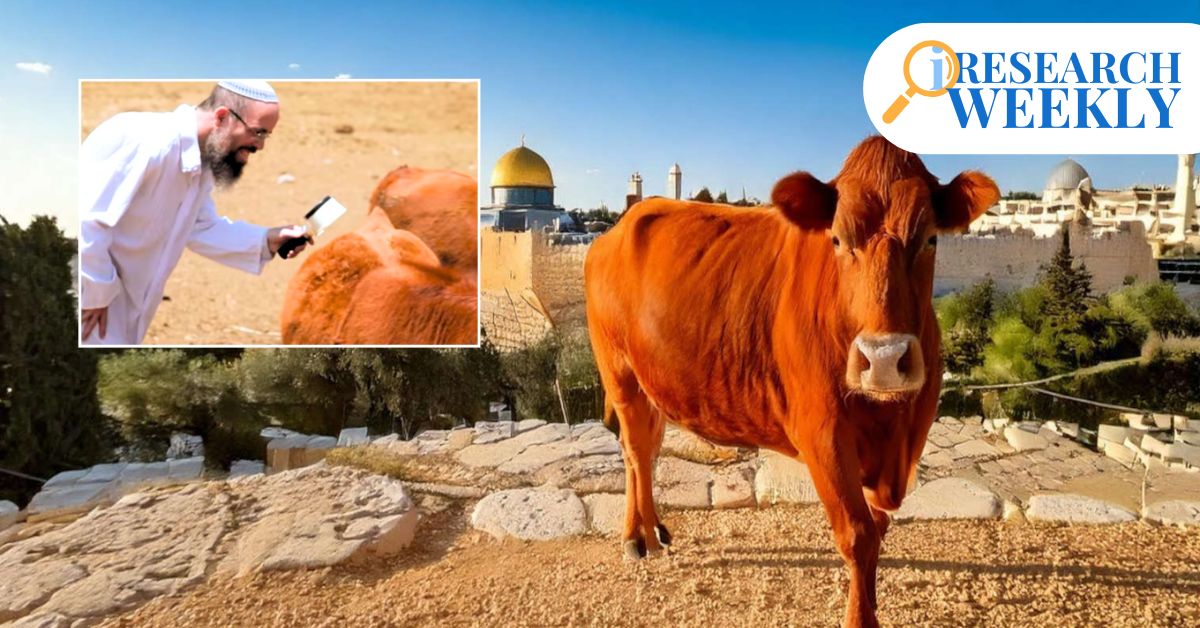
In the heart of Jerusalem, a ritual involving a red heifer has reignited ancient prophecies—and iResearch Weekly sat down with the man who stands at the center of it all.
On the 100th day of the war sparked by Hamas’s October 7, 2023 attack on Israel—which killed roughly 1,200 men, women, and children and saw 251 taken hostage—Hamas spokesman Abu Ubaida gave a shocking explanation for the assault.
Beyond the familiar rhetoric of “occupation” and “stolen land,” Ubaida blamed the “bringing of red cows” into Israel—a reference to the biblical red heifers—as a provocation grave enough to justify the attack. Hamas called their brutal operation “Al-Aqsa Flood”, framing it as a defense of the Al-Aqsa Mosque—known to Jews as the Temple Mount.
The Temple Mount: History’s Most Contested Plot of Land
For millennia, the Temple Mount has been the spiritual epicenter of Judaism—and perhaps the most explosive flashpoint in the world.
-
960 BCE: King Solomon builds the First Temple to the God of Israel in Jerusalem.
-
586 BCE: The Babylonians destroy it; scripture and archaeology confirm the devastation.
-
516 BCE – 70 CE: The Second Temple stands, later expanded by Herod, before the Romans raze it and scatter the Jewish people.
-
691 CE: Under Caliph Abd al-Malik, Muslim colonizers construct the Dome of the Rock atop the ruins, naming it Masjid Al-Aqsa—“the furthest mosque.”
Though exiled for centuries, a Jewish remnant persisted in Jerusalem, living as dhimmis (subjugated second-class citizens) under Muslim rule, as well as under Roman and later British control.
After Israel’s victory in the 1967 Six-Day War, Israeli military forces regained East Jerusalem and the Temple Mount—but, in a bid for peace, returned custodianship of the site to Jordan’s Islamic Waqf. Since then, this tiny hilltop has remained the most volatile nook on Earth.

So, What’s the Deal With “Red Cows”?
For generations, the dream has burned in the hearts of devout Jews — the vision of returning to their ancient homeland and restoring the Holy Temple in Jerusalem. In 1987, that vision was synergized with the formation of The Temple Institute, an organization dedicated to one mission: fulfilling the biblical command to rebuild the Temple on Mount Moriah.
Since then, the Institute has pursued a sacred and elusive goal — the search for a ritually pure red heifer, the key to ritual purification described in Numbers 19, where the following instruction is given:
Then the Lord spoke to Moses and Aaron, saying, “This is the statute of the law which the Lord has commanded, saying ‘Speak to the sons of Israel that they bring you an unblemished red heifer in which there is no defect and on which a yoke has never been mounted. And you shall give it to Eleazar the priest, and it shall be brought outside the camp and be slaughtered in his presence.’
To be chosen, a heifer must meet the following criteria:
-
It must be an adult cow with reddish-brown hair.
-
Its coat must be entirely uniform, with no hairs of a different color.
-
It must be completely free of blemishes.
-
It must never have been used for labor or any other purpose.
According to the commandment, the ashes of the red heifer were then to be mixed with water from a living spring. This water could then be sprinkled on the Temple priests and the people of Israel, purifying them from the ritual impurity associated with death and decay.
Ancient rabbinic sources reveal only nine red heifers have been used in the purification ceremony, since the time of Moses. The last time a qualifying animal was found was in 70 AD, at the time of the Second Temple’s destruction.
For decades, the quest to find another has stirred hope and skepticism alike. And for as long as the author can remember, from whispered tales in childhood to the latest headlines, every attempt to find the perfect animal has ended with the same result — disappointment.
Over time, the hunt for the perfect red heifer — like the legendary quest for the Ark of the Covenant — took on the air of a biblical myth, more at home in an Indiana Jones adventure than in modern-day Israel.
In September 2022, a Christian businessman from Texas named Byron Stinson quietly accomplished something unprecedented.
Working with Israeli Rabbi Yitzchak Mamo and their nonprofit Boneh Israel, Stinson shipped five flawless red heifers from Texas to Shiloh, Israel — animals raised under biblical standards so strict that even a few stray white or black hairs could disqualify them.
Their purpose? To fulfill the ancient command from Scripture — the necessary first step before rebuilding the Jewish Temple. Boneh Israel then partnered with the Temple Institute to produce the sacred ashes required for rebuilding the Jerusalem Temple.
For believers, it was a historic milestone. For Muslim hardliners, it was a provocation — a sign that Jews were preparing to reclaim the Al-Aqsa compound.
Within months, the region would explode.
A Theological Divide
For religious Jews, the rebuilding of the Temple is not a matter of mere sentiment — it is a divine command. The Torah mandates it, and generations of rabbis and scholars have understood it as an essential step in the Ge’ulah, (prophesied worldwide redemption). The Temple in Jerusalem is not merely a relic of the past; it is the beating heart of Israel’s spiritual calling and identity.
The main point of debate among Jewish sects is the timing: should the Temple be rebuilt before or after the arrival of the Messiah? Most religious Jews maintain that the Temple’s reconstruction depends on the obedience of the Jewish people, rather than being a miraculous act from heaven.
Among Christians, however, the idea of a Third Temple sparks fierce debate. The discussion often hinges less on archaeology or politics, and more on beliefs about soteriology (how people are “saved”) and eschatology (beliefs about the end times).
Many Christians oppose participation in any rebuilding effort, arguing that a restored system of sacrifices would deny the sufficiency of Jesus’s death and resurrection. Jesus, they argue, fulfilled the Temple’s sacrificial requirements. The Jerusalem Temple is therefore viewed as an outright rejection of this truth.
Others, citing their own prophetic interpretations, warn that Scripture foretells the rise of an Antichrist who will desecrate a rebuilt Temple and claim divine authority over it — a detail that makes any movement toward reconstruction troubling.
Not all Christians share these sentiments.
The Case for Christian Support
Some Christians advocate for Israel’s right to rebuild, not primarily from theological grounds but from principles of national sovereignty as well as human and religious rights. “Muslims have Mecca,” they argue. “Isn’t it fair that Jews should also be free to worship at their holiest site — the Temple Mount — in their own capital, Jerusalem?” To them, denying the right of Jews to worship on the Temple Mount does not reflect theological commitment, but political inconsistency.
Still others approach the question through a prophetic lens. They point to prophecies describing the Jewish people’s return from exile to their ancestral land as a prelude to redemption. They note that while the Apostle Paul foretold a future defilement of the Temple by the Antichrist, he nonetheless referred to it as “the Temple of God” (2 Thessalonians 2:4). The First and Second Temples, they remind us, were also desecrated and destroyed — yet history remembers those structures as God’s House, not Nebuchadnezzar’s or Antiochus Epiphanes’s. Why then should the Third Temple be viewed as “the Antichrist’s Temple”?
For many premillennialists, the current Jewish rejection of Jesus is seen as temporary. They believe that after “the fullness of the Gentiles” has come in, a future generation of Israel will “look upon the one they pierced” and experience a national awakening. From this view, the rebuilding of the Temple may be less about the efficacy of animal sacrifices, and more about divine orchestration — a necessary prophetic milestone in the unfolding of redemptive history.
Might it be that, as the blood of animal sacrifices compels Israel to confront once more the mysteries of sin and atonement, their engagement in these ancient rites subtly points them towards the Messiah who died for sin and rose again?
Even Jesus himself, they point out, prophesied that a future generation of Jerusalem’s inhabitants would recognize him and welcome him back (Matthew 23:37–39). “Should we resist what God, in His sovereignty, has already decreed?” they would ask. “Or should we look up and rejoice; anticipating the unfolding of prophecy on Mount Moriah?”
Why Hamas “Saw Red”
In Islamic teaching, once a place is conquered for Islam, it must remain so forever. The notion of Jewish ritual purity and Temple restoration atop the site once conquered and claimed by Islamic invaders, is therefore intolerable.
Captured Hamas correspondences to other Islamic governments suggest Hamas’s October 7 attack—originally planned for a later date—was accelerated by the arrival of the red heifers. Ubaida denounced the planned ceremony as “a detestable religious myth,” linking it directly to the assault.
The Ceremony That Shook Shiloh
Before the war, Boneh Israel and the Temple Institute of Jerusalem intended to perform the red heifer ritual on the Mount of Olives during Passover 2024. The conflict delayed their plans—and as the cows aged, two were disqualified under strict rabbinic inspection for stray white or black hairs.
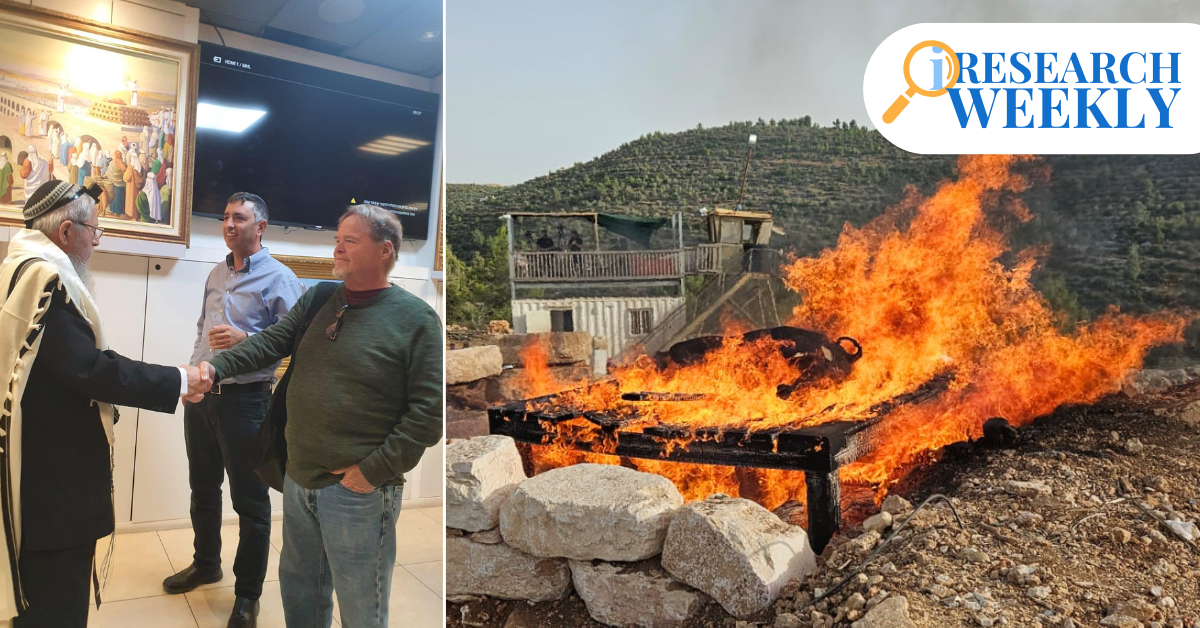
Finally, on July 1, 2025, a “practice run” was conducted in Shiloh, ancient Samaria. A seconds-long video clip of the burning red heifer went viral, igniting fierce debate among end-times prophecy scholars and religious observers worldwide.

Controversy and Confusion
While the Bible merely commands the use of the red heifer’s ashes, it specifies no location for the ritual slaughter. Rabbinic tradition (as found in the Talmud), however, maintains that the sacrifice must occur on the Mount of Olives to be valid. Critics, therefore, claimed the Shiloh ceremony was merely symbolic, with some even alleging the chosen heifer had been bitten by a dog and therefore disqualified.
Israeli journalist Adam Eliyahu Berkowitz of Israel365News initially dismissed the event as ineffectual. But in mid October, he issued a surprising retraction and apology, admitting that the true nature of the July ceremony might not have been as he’d been told.
Since the release of Berkowitz’s retraction video, the July sacrifice has reemerged as a topic of interest; with many speculating as to whether the ritual was “official” or not.
What Really Happened?
The mystery deepens. Were the ashes from the July ceremony legitimate? Did Israel quietly take its first steps toward rebuilding the Temple?
To find out, iResearch Weekly sat down with Byron Stinson, the man at the center of it all. In an exclusive interview, he reveals what actually happened in Shiloh, how Israeli religious authorities view the ritual, and what may come next for those awaiting the Third Temple.
Our interview with Byron Stinson will be published on November 4th.



One thought on “The Truth About the Red Heifer, the Temple Mount, and the War That Shook the World”